2.4 공간 복잡도
공간 복잡도(space complexity)는 데이터 양이 많아질 때 알고리즘이 차지하는 메모리 공간이 증가하는 추세를 측정한다. 시간 복잡도와 매우 비슷한 개념으로, ‘실행 시간’을 ‘차지하는 메모리 공간’으로 바꾸면 된다.
2.4.1 알고리즘과 관련된 공간
알고리즘이 실행 중 사용하는 메모리 공간에는 주로 다음과 같은 종류가 있다.
- 입력 공간: 알고리즘의 입력 데이터를 저장한다.
- 임시 공간: 실행 중의 변수, 객체, 함수 문맥 등의 데이터를 저장한다.
- 출력 공간: 알고리즘의 출력 데이터를 저장한다.
일반적으로 공간 복잡도에 포함하는 범위는 ‘임시 공간’과 ‘출력 공간’의 합이다.
임시 공간은 다시 세 부분으로 나눌 수 있다.
- 임시 데이터: 실행 중의 각종 상수, 변수, 객체 등을 저장한다.
- 스택 프레임 공간: 호출한 함수의 문맥 데이터를 저장한다. 시스템은 함수가 호출될 때마다 스택 맨 위에 스택 프레임을 만들며, 함수가 반환되면 이 공간을 해제한다.
- 명령어 공간: 컴파일된 프로그램 명령어를 저장하며, 실제 계산에서는 보통 무시한다.
프로그램의 공간 복잡도를 분석할 때는 아래 그림(2-15)과 같이 보통 임시 데이터, 스택 프레임 공간, 출력 데이터의 세 부분을 계산한다.
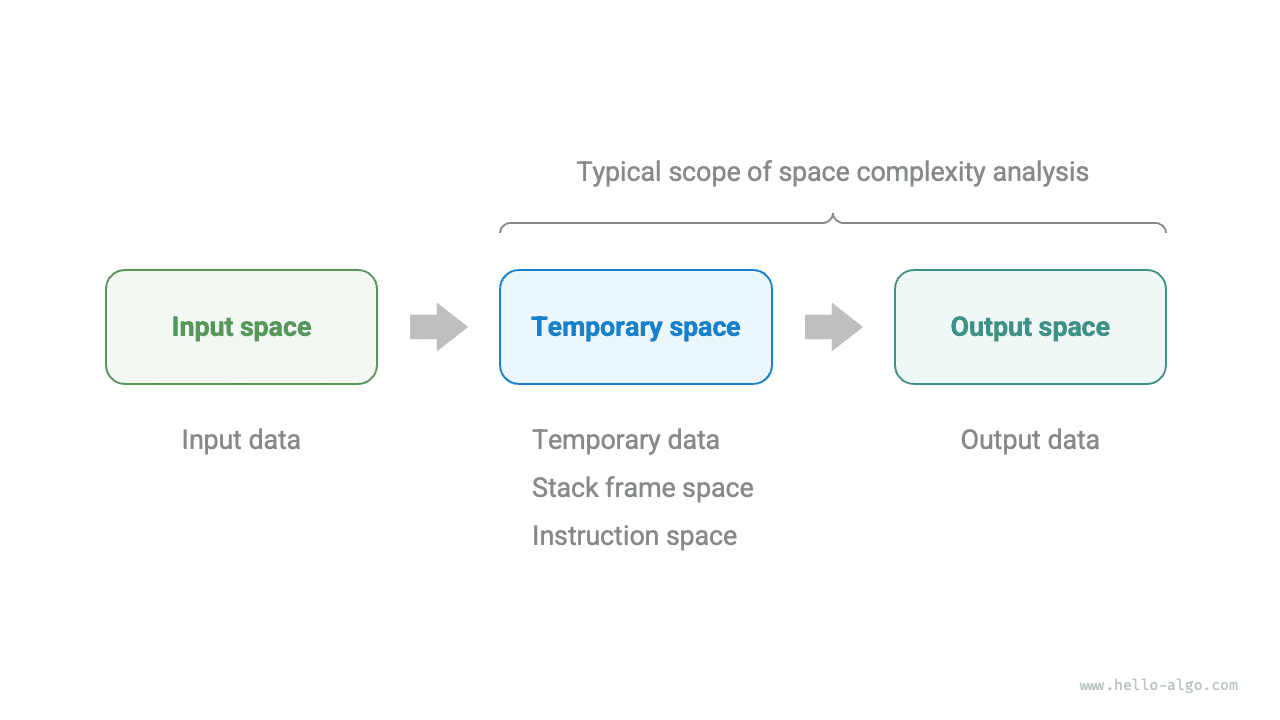
그림 2-15 알고리즘이 사용하는 공간
관련 코드는 다음과 같다.
class Node:
    """클래스"""
    def __init__(self, x: int):
        self.val: int = x              # 노드 값
        self.next: Node | None = None  # 다음 노드를 가리키는 참조

def function() -> int:
    """함수"""
    # 몇 가지 연산 수행...
    return 0

def algorithm(n) -> int:  # 입력 데이터
    A = 0                 # 임시 데이터(상수, 보통 대문자로 표기)
    b = 0                 # 임시 데이터(변수)
    node = Node(0)        # 임시 데이터(객체)
    c = function()        # 스택 프레임 공간(함수 호출)
    return A + b + c      # 출력 데이터
/* 구조체 */
struct Node {
    int val;
    Node *next;
    Node(int x) : val(x), next(nullptr) {}
};

/* 함수 */
int func() {
    // 몇 가지 연산 수행...
    return 0;
}

int algorithm(int n) {        // 입력 데이터
    const int a = 0;          // 임시 데이터(상수)
    int b = 0;                // 임시 데이터(변수)
    Node* node = new Node(0); // 임시 데이터(객체)
    int c = func();           // 스택 프레임 공간(함수 호출)
    return a + b + c;         // 출력 데이터
}
/* 클래스 */
class Node {
    int val;
    Node next;
    Node(int x) { val = x; }
}

/* 함수 */
int function() {
    // 몇 가지 연산 수행...
    return 0;
}

int algorithm(int n) {        // 입력 데이터
    final int a = 0;          // 임시 데이터(상수)
    int b = 0;                // 임시 데이터(변수)
    Node node = new Node(0);  // 임시 데이터(객체)
    int c = function();       // 스택 프레임 공간(함수 호출)
    return a + b + c;         // 출력 데이터
}
/* 클래스 */
class Node(int x) {
    int val = x;
    Node next;
}

/* 함수 */
int Function() {
    // 몇 가지 연산 수행...
    return 0;
}

int Algorithm(int n) {        // 입력 데이터
    const int a = 0;          // 임시 데이터(상수)
    int b = 0;                // 임시 데이터(변수)
    Node node = new(0);       // 임시 데이터(객체)
    int c = Function();       // 스택 프레임 공간(함수 호출)
    return a + b + c;         // 출력 데이터
}
/* 구조체 */
type node struct {
    val  int
    next *node
}

/* node 구조체 생성  */
func newNode(val int) *node {
    return &node{val: val}
}

/* 함수 */
func function() int {
    // 몇 가지 연산 수행...
    return 0
}

func algorithm(n int) int { // 입력 데이터
    const a = 0             // 임시 데이터(상수)
    b := 0                  // 임시 데이터(변수)
    newNode(0)              // 임시 데이터(객체)
    c := function()         // 스택 프레임 공간(함수 호출)
    return a + b + c        // 출력 데이터
}
/* 클래스 */
class Node {
    var val: Int
    var next: Node?

    init(x: Int) {
        val = x
    }
}

/* 함수 */
func function() -> Int {
    // 몇 가지 연산 수행...
    return 0
}

func algorithm(n: Int) -> Int { // 입력 데이터
    let a = 0             // 임시 데이터(상수)
    var b = 0             // 임시 데이터(변수)
    let node = Node(x: 0) // 임시 데이터(객체)
    let c = function()    // 스택 프레임 공간(함수 호출)
    return a + b + c      // 출력 데이터
}
/* 클래스 */
class Node {
    val;
    next;
    constructor(val) {
        this.val = val === undefined ? 0 : val; // 노드 값
        this.next = null;                       // 다음 노드를 가리키는 참조
    }
}

/* 함수 */
function constFunc() {
    // 몇 가지 연산 수행
    return 0;
}

function algorithm(n) {       // 입력 데이터
    const a = 0;              // 임시 데이터(상수)
    let b = 0;                // 임시 데이터(변수)
    const node = new Node(0); // 임시 데이터(객체)
    const c = constFunc();    // 스택 프레임 공간(함수 호출)
    return a + b + c;         // 출력 데이터
}
/* 클래스 */
class Node {
    val: number;
    next: Node | null;
    constructor(val?: number) {
        this.val = val === undefined ? 0 : val; // 노드 값
        this.next = null;                       // 다음 노드를 가리키는 참조
    }
}

/* 함수 */
function constFunc(): number {
    // 몇 가지 연산 수행
    return 0;
}

function algorithm(n: number): number { // 입력 데이터
    const a = 0;                        // 임시 데이터(상수)
    let b = 0;                          // 임시 데이터(변수)
    const node = new Node(0);           // 임시 데이터(객체)
    const c = constFunc();              // 스택 프레임 공간(함수 호출)
    return a + b + c;                   // 출력 데이터
}
/* 클래스 */
class Node {
  int val;
  Node next;
  Node(this.val, [this.next]);
}

/* 함수 */
int function() {
  // 몇 가지 연산 수행...
  return 0;
}

int algorithm(int n) {  // 입력 데이터
  const int a = 0;      // 임시 데이터(상수)
  int b = 0;            // 임시 데이터(변수)
  Node node = Node(0);  // 임시 데이터(객체)
  int c = function();   // 스택 프레임 공간(함수 호출)
  return a + b + c;     // 출력 데이터
}
use std::rc::Rc;
use std::cell::RefCell;

/* 구조체 */
struct Node {
    val: i32,
    next: Option<Rc<RefCell<Node>>>,
}

/* Node 구조체 생성 */
impl Node {
    fn new(val: i32) -> Self {
        Self { val: val, next: None }
    }
}

/* 함수 */
fn function() -> i32 {
    // 몇 가지 연산 수행...
    return 0;
}

fn algorithm(n: i32) -> i32 {       // 입력 데이터
    const a: i32 = 0;               // 임시 데이터(상수)
    let mut b = 0;                  // 임시 데이터(변수)
    let node = Node::new(0);        // 임시 데이터(객체)
    let c = function();             // 스택 프레임 공간(함수 호출)
    return a + b + c;               // 출력 데이터
}
/* 클래스 */
class Node(var _val: Int) {
    var next: Node? = null
}

/* 함수 */
fun function(): Int {
    // 몇 가지 연산 수행...
    return 0
}

fun algorithm(n: Int): Int { // 입력 데이터
    val a = 0                // 임시 데이터(상수)
    var b = 0                // 임시 데이터(변수)
    val node = Node(0)       // 임시 데이터(객체)
    val c = function()       // 스택 프레임 공간(함수 호출)
    return a + b + c         // 출력 데이터
}
### 클래스 ###
class Node
    attr_accessor :val      # 노드 값
    attr_accessor :next     # 다음 노드를 가리키는 참조

    def initialize(x)
        @val = x
    end
end

### 함수 ###
def function
    # 몇 가지 연산 수행...
    0
end

### 알고리즘 ###
def algorithm(n)        # 입력 데이터
    a = 0               # 임시 데이터(상수)
    b = 0               # 임시 데이터(변수)
    node = Node.new(0)  # 임시 데이터(객체)
    c = function        # 스택 프레임 공간(함수 호출)
    a + b + c           # 출력 데이터
end
2.4.2 계산 방법
공간 복잡도를 구하는 방법은 시간 복잡도와 대체로 같다. 계산 대상을 ‘연산 횟수’에서 ‘사용 공간의 크기’로 바꾸면 된다.
시간 복잡도와 달리 보통 최악 공간 복잡도에만 관심을 둔다. 메모리 공간은 반드시 충족해야 하는 요구 사항이므로, 어떤 입력 데이터에서도 충분한 메모리 공간이 확보되어 있어야 하기 때문이다.
다음 코드를 보면 최악 공간 복잡도에서 ‘최악’은 두 가지 의미를 지닌다.
- 가장 불리한 입력 데이터를 기준으로 한다: \(n < 10\)이면 공간 복잡도는 \(O(1)\)이다. 그러나 \(n > 10\)이면 초기화한 배열
nums가 \(O(n)\) 공간을 차지하므로 최악 공간 복잡도는 \(O(n)\)이다. - 알고리즘 실행 중 최대 메모리 사용량을 기준으로 한다: 예를 들어 프로그램이 마지막 줄을 실행하기 전에는 \(O(1)\) 공간을 차지하지만, 배열
nums를 초기화하면 \(O(n)\) 공간을 차지한다. 따라서 최악 공간 복잡도는 \(O(n)\)이다.
재귀 함수에서는 스택 프레임 공간을 계산하는 데 주의해야 한다. 다음 코드를 살펴보자.
함수 loop()와 recur()의 시간 복잡도는 모두 \(O(n)\)이지만 공간 복잡도는 다르다.
- 함수
loop()는 반복문에서function()을 \(n\)번 호출한다. 매번function()이 반환되어 스택 프레임 공간이 해제되므로, 공간 복잡도는 여전히 \(O(1)\)이다. - 재귀 함수
recur()의 실행 중에는 아직 반환되지 않은recur()가 \(n\)개 동시에 존재하므로, \(O(n)\)의 스택 프레임 공간을 차지한다.
2.4.3 대표적인 유형
입력 데이터 크기를 \(n\)이라고 할 때, 아래 그림(2-16)은 대표적인 공간 복잡도 유형을 낮은 순서대로 보여 준다.
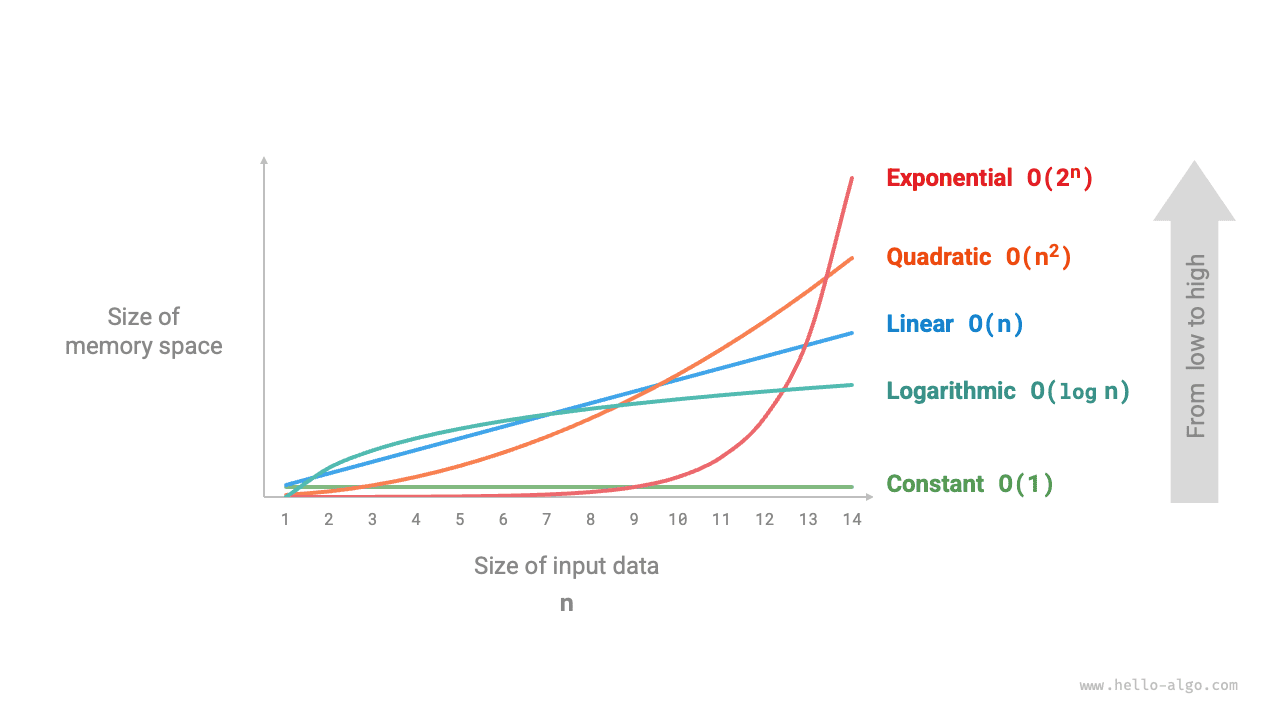
그림 2-16 대표적인 공간 복잡도 유형
1. 상수 공간 \(O(1)\)
상수 공간은 개수가 입력 데이터 크기 \(n\)과 무관한 상수, 변수, 객체에서 흔히 나타난다.
반복문에서 변수를 초기화하거나 함수를 호출할 때 사용하는 메모리는 다음 반복에 들어가면 해제되므로 공간이 누적되지 않는다. 따라서 공간 복잡도는 여전히 \(O(1)\)이다.
/* 함수 */
int func() {
    // 몇 가지 연산을 수행한다
    return 0;
}

/* 상수 차수 */
void constant(int n) {
    // 상수, 변수, 객체는 O(1) 공간을 차지한다
    const int a = 0;
    int b = 0;
    vector<int> nums(10000);
    ListNode node(0);
    // 반복문 안의 변수는 O(1) 공간을 차지한다
    for (int i = 0; i < n; i++) {
        int c = 0;
    }
    // 반복문 안의 함수는 O(1) 공간을 차지한다
    for (int i = 0; i < n; i++) {
        func();
    }
}
/* 함수 */
int function() {
    // 몇 가지 연산을 수행한다
    return 0;
}

/* 상수 차수 */
void constant(int n) {
    // 상수, 변수, 객체는 O(1) 공간을 차지한다
    final int a = 0;
    int b = 0;
    int[] nums = new int[10000];
    ListNode node = new ListNode(0);
    // 반복문 안의 변수는 O(1) 공간을 차지한다
    for (int i = 0; i < n; i++) {
        int c = 0;
    }
    // 반복문 안의 함수는 O(1) 공간을 차지한다
    for (int i = 0; i < n; i++) {
        function();
    }
}
/* 함수 */
int Function() {
    // 몇 가지 연산을 수행한다
    return 0;
}

/* 상수 차수 */
void Constant(int n) {
    // 상수, 변수, 객체는 O(1) 공간을 차지한다
    int a = 0;
    int b = 0;
    int[] nums = new int[10000];
    ListNode node = new(0);
    // 반복문 안의 변수는 O(1) 공간을 차지한다
    for (int i = 0; i < n; i++) {
        int c = 0;
    }
    // 반복문 안의 함수는 O(1) 공간을 차지한다
    for (int i = 0; i < n; i++) {
        Function();
    }
}
/* 함수 */
func function() int {
    // 몇 가지 연산을 수행한다...
    return 0
}

/* 상수 차수 */
func spaceConstant(n int) {
    // 상수, 변수, 객체는 O(1) 공간을 차지한다
    const a = 0
    b := 0
    nums := make([]int, 10000)
    node := newNode(0)
    // 반복문 안의 변수는 O(1) 공간을 차지한다
    var c int
    for i := 0; i < n; i++ {
        c = 0
    }
    // 반복문 안의 함수는 O(1) 공간을 차지한다
    for i := 0; i < n; i++ {
        function()
    }
    b += 0
    c += 0
    nums[0] = 0
    node.val = 0
}
/* 함수 */
@discardableResult
func function() -> Int {
    // 몇 가지 연산을 수행한다
    return 0
}

/* 상수 차수 */
func constant(n: Int) {
    // 상수, 변수, 객체는 O(1) 공간을 차지한다
    let a = 0
    var b = 0
    let nums = Array(repeating: 0, count: 10000)
    let node = ListNode(x: 0)
    // 반복문 안의 변수는 O(1) 공간을 차지한다
    for _ in 0 ..< n {
        let c = 0
    }
    // 반복문 안의 함수는 O(1) 공간을 차지한다
    for _ in 0 ..< n {
        function()
    }
}
/* 함수 */
function constFunc() {
    // 몇 가지 연산을 수행한다
    return 0;
}

/* 상수 차수 */
function constant(n) {
    // 상수, 변수, 객체는 O(1) 공간을 차지한다
    const a = 0;
    const b = 0;
    const nums = new Array(10000);
    const node = new ListNode(0);
    // 반복문 안의 변수는 O(1) 공간을 차지한다
    for (let i = 0; i < n; i++) {
        const c = 0;
    }
    // 반복문 안의 함수는 O(1) 공간을 차지한다
    for (let i = 0; i < n; i++) {
        constFunc();
    }
}
/* 함수 */
function constFunc(): number {
    // 몇 가지 연산을 수행한다
    return 0;
}

/* 상수 차수 */
function constant(n: number): void {
    // 상수, 변수, 객체는 O(1) 공간을 차지한다
    const a = 0;
    const b = 0;
    const nums = new Array(10000);
    const node = new ListNode(0);
    // 반복문 안의 변수는 O(1) 공간을 차지한다
    for (let i = 0; i < n; i++) {
        const c = 0;
    }
    // 반복문 안의 함수는 O(1) 공간을 차지한다
    for (let i = 0; i < n; i++) {
        constFunc();
    }
}
/* 함수 */
int function() {
  // 몇 가지 연산을 수행한다
  return 0;
}

/* 상수 차수 */
void constant(int n) {
  // 상수, 변수, 객체는 O(1) 공간을 차지한다
  final int a = 0;
  int b = 0;
  List<int> nums = List.filled(10000, 0);
  ListNode node = ListNode(0);
  // 반복문 안의 변수는 O(1) 공간을 차지한다
  for (var i = 0; i < n; i++) {
    int c = 0;
  }
  // 반복문 안의 함수는 O(1) 공간을 차지한다
  for (var i = 0; i < n; i++) {
    function();
  }
}
/* 함수 */
fn function() -> i32 {
    // 몇 가지 연산을 수행한다
    return 0;
}

/* 상수 차수 */
#[allow(unused)]
fn constant(n: i32) {
    // 상수, 변수, 객체는 O(1) 공간을 차지한다
    const A: i32 = 0;
    let b = 0;
    let nums = vec![0; 10000];
    let node = ListNode::new(0);
    // 반복문 안의 변수는 O(1) 공간을 차지한다
    for i in 0..n {
        let c = 0;
    }
    // 반복문 안의 함수는 O(1) 공간을 차지한다
    for i in 0..n {
        function();
    }
}
/* 함수 */
int func() {
    // 몇 가지 연산을 수행한다
    return 0;
}

/* 상수 차수 */
void constant(int n) {
    // 상수, 변수, 객체는 O(1) 공간을 차지한다
    const int a = 0;
    int b = 0;
    int nums[1000];
    ListNode *node = newListNode(0);
    free(node);
    // 반복문 안의 변수는 O(1) 공간을 차지한다
    for (int i = 0; i < n; i++) {
        int c = 0;
    }
    // 반복문 안의 함수는 O(1) 공간을 차지한다
    for (int i = 0; i < n; i++) {
        func();
    }
}
/* 함수 */
fun function(): Int {
    // 몇 가지 연산을 수행한다
    return 0
}

/* 상수 차수 */
fun constant(n: Int) {
    // 상수, 변수, 객체는 O(1) 공간을 차지한다
    val a = 0
    var b = 0
    val nums = Array(10000) { 0 }
    val node = ListNode(0)
    // 반복문 안의 변수는 O(1) 공간을 차지한다
    for (i in 0..<n) {
        val c = 0
    }
    // 반복문 안의 함수는 O(1) 공간을 차지한다
    for (i in 0..<n) {
        function()
    }
}
코드 시각화
2. 선형 공간 \(O(n)\)
선형 공간은 원소 수가 \(n\)에 비례하는 배열, 연결 리스트, 스택, 큐 등에 흔히 나타난다.
/* 선형 차수 */
void linear(int n) {
    // 길이가 n인 배열은 O(n) 공간을 차지한다
    vector<int> nums(n);
    // 길이가 n인 리스트는 O(n) 공간을 차지한다
    vector<ListNode> nodes;
    for (int i = 0; i < n; i++) {
        nodes.push_back(ListNode(i));
    }
    // 길이가 n인 해시 테이블은 O(n) 공간을 차지한다
    unordered_map<int, string> map;
    for (int i = 0; i < n; i++) {
        map[i] = to_string(i);
    }
}
/* 선형 차수 */
void linear(int n) {
    // 길이가 n인 배열은 O(n) 공간을 차지한다
    int[] nums = new int[n];
    // 길이가 n인 리스트는 O(n) 공간을 차지한다
    List<ListNode> nodes = new ArrayList<>();
    for (int i = 0; i < n; i++) {
        nodes.add(new ListNode(i));
    }
    // 길이가 n인 해시 테이블은 O(n) 공간을 차지한다
    Map<Integer, String> map = new HashMap<>();
    for (int i = 0; i < n; i++) {
        map.put(i, String.valueOf(i));
    }
}
/* 선형 차수 */
void Linear(int n) {
    // 길이가 n인 배열은 O(n) 공간을 차지한다
    int[] nums = new int[n];
    // 길이가 n인 리스트는 O(n) 공간을 차지한다
    List<ListNode> nodes = [];
    for (int i = 0; i < n; i++) {
        nodes.Add(new ListNode(i));
    }
    // 길이가 n인 해시 테이블은 O(n) 공간을 차지한다
    Dictionary<int, string> map = [];
    for (int i = 0; i < n; i++) {
        map.Add(i, i.ToString());
    }
}
/* 선형 차수 */
func spaceLinear(n int) {
    // 길이가 n인 배열은 O(n) 공간을 차지한다
    _ = make([]int, n)
    // 길이가 n인 리스트는 O(n) 공간을 차지한다
    var nodes []*node
    for i := 0; i < n; i++ {
        nodes = append(nodes, newNode(i))
    }
    // 길이가 n인 해시 테이블은 O(n) 공간을 차지한다
    m := make(map[int]string, n)
    for i := 0; i < n; i++ {
        m[i] = strconv.Itoa(i)
    }
}
/* 선형 차수 */
func linear(n: Int) {
    // 길이가 n인 배열은 O(n) 공간을 차지한다
    let nums = Array(repeating: 0, count: n)
    // 길이가 n인 리스트는 O(n) 공간을 차지한다
    let nodes = (0 ..< n).map { ListNode(x: $0) }
    // 길이가 n인 해시 테이블은 O(n) 공간을 차지한다
    let map = Dictionary(uniqueKeysWithValues: (0 ..< n).map { ($0, "\($0)") })
}
/* 선형 차수 */
function linear(n) {
    // 길이가 n인 배열은 O(n) 공간을 차지한다
    const nums = new Array(n);
    // 길이가 n인 리스트는 O(n) 공간을 차지한다
    const nodes = [];
    for (let i = 0; i < n; i++) {
        nodes.push(new ListNode(i));
    }
    // 길이가 n인 해시 테이블은 O(n) 공간을 차지한다
    const map = new Map();
    for (let i = 0; i < n; i++) {
        map.set(i, i.toString());
    }
}
/* 선형 차수 */
function linear(n: number): void {
    // 길이가 n인 배열은 O(n) 공간을 차지한다
    const nums = new Array(n);
    // 길이가 n인 리스트는 O(n) 공간을 차지한다
    const nodes: ListNode[] = [];
    for (let i = 0; i < n; i++) {
        nodes.push(new ListNode(i));
    }
    // 길이가 n인 해시 테이블은 O(n) 공간을 차지한다
    const map = new Map();
    for (let i = 0; i < n; i++) {
        map.set(i, i.toString());
    }
}
/* 선형 차수 */
void linear(int n) {
  // 길이가 n인 배열은 O(n) 공간을 차지한다
  List<int> nums = List.filled(n, 0);
  // 길이가 n인 리스트는 O(n) 공간을 차지한다
  List<ListNode> nodes = [];
  for (var i = 0; i < n; i++) {
    nodes.add(ListNode(i));
  }
  // 길이가 n인 해시 테이블은 O(n) 공간을 차지한다
  Map<int, String> map = HashMap();
  for (var i = 0; i < n; i++) {
    map.putIfAbsent(i, () => i.toString());
  }
}
/* 선형 차수 */
#[allow(unused)]
fn linear(n: i32) {
    // 길이가 n인 배열은 O(n) 공간을 차지한다
    let mut nums = vec![0; n as usize];
    // 길이가 n인 리스트는 O(n) 공간을 차지한다
    let mut nodes = Vec::new();
    for i in 0..n {
        nodes.push(ListNode::new(i))
    }
    // 길이가 n인 해시 테이블은 O(n) 공간을 차지한다
    let mut map = HashMap::new();
    for i in 0..n {
        map.insert(i, i.to_string());
    }
}
/* 해시 테이블 */
typedef struct {
    int key;
    int val;
    UT_hash_handle hh; // uthash.h를 기반으로 구현한다
} HashTable;

/* 선형 차수 */
void linear(int n) {
    // 길이가 n인 배열은 O(n) 공간을 차지한다
    int *nums = malloc(sizeof(int) * n);
    free(nums);

    // 길이가 n인 리스트는 O(n) 공간을 차지한다
    ListNode **nodes = malloc(sizeof(ListNode *) * n);
    for (int i = 0; i < n; i++) {
        nodes[i] = newListNode(i);
    }
    // 메모리 해제
    for (int i = 0; i < n; i++) {
        free(nodes[i]);
    }
    free(nodes);

    // 길이가 n인 해시 테이블은 O(n) 공간을 차지한다
    HashTable *h = NULL;
    for (int i = 0; i < n; i++) {
        HashTable *tmp = malloc(sizeof(HashTable));
        tmp->key = i;
        tmp->val = i;
        HASH_ADD_INT(h, key, tmp);
    }

    // 메모리 해제
    HashTable *curr, *tmp;
    HASH_ITER(hh, h, curr, tmp) {
        HASH_DEL(h, curr);
        free(curr);
    }
}
/* 선형 차수 */
fun linear(n: Int) {
    // 길이가 n인 배열은 O(n) 공간을 차지한다
    val nums = Array(n) { 0 }
    // 길이가 n인 리스트는 O(n) 공간을 차지한다
    val nodes = mutableListOf<ListNode>()
    for (i in 0..<n) {
        nodes.add(ListNode(i))
    }
    // 길이가 n인 해시 테이블은 O(n) 공간을 차지한다
    val map = mutableMapOf<Int, String>()
    for (i in 0..<n) {
        map[i] = i.toString()
    }
}
코드 시각화
아래 그림(2-17)과 같이 이 함수의 재귀 깊이는 \(n\)이다. 즉, 아직 반환되지 않은 linear_recur() 함수가 \(n\)개 동시에 존재하며 \(O(n)\) 크기의 스택 프레임 공간을 사용한다.
코드 시각화
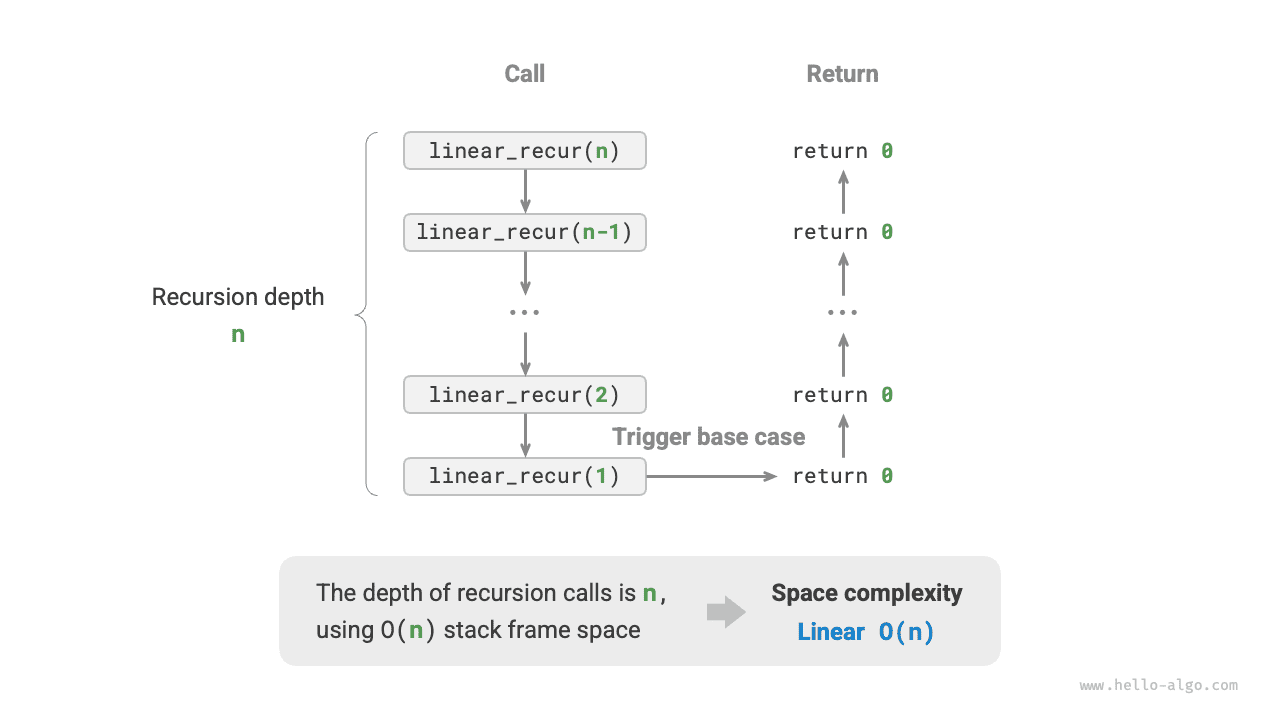
그림 2-17 재귀 함수에서 발생하는 선형 공간 복잡도
3. 제곱 공간 \(O(n^2)\)
제곱 공간은 원소 수가 \(n\)의 제곱에 비례하는 행렬과 그래프에 흔히 나타난다.
/* 제곱 차수 */
void quadratic(int n) {
    // 행렬은 O(n^2) 공간을 차지한다
    int[][] numMatrix = new int[n][n];
    // 이차원 리스트는 O(n^2) 공간을 차지한다
    List<List<Integer>> numList = new ArrayList<>();
    for (int i = 0; i < n; i++) {
        List<Integer> tmp = new ArrayList<>();
        for (int j = 0; j < n; j++) {
            tmp.add(0);
        }
        numList.add(tmp);
    }
}
/* 제곱 차수 */
function quadratic(n) {
    // 행렬은 O(n^2) 공간을 차지한다
    const numMatrix = Array(n)
        .fill(null)
        .map(() => Array(n).fill(null));
    // 이차원 리스트는 O(n^2) 공간을 차지한다
    const numList = [];
    for (let i = 0; i < n; i++) {
        const tmp = [];
        for (let j = 0; j < n; j++) {
            tmp.push(0);
        }
        numList.push(tmp);
    }
}
/* 제곱 차수 */
function quadratic(n: number): void {
    // 행렬은 O(n^2) 공간을 차지한다
    const numMatrix = Array(n)
        .fill(null)
        .map(() => Array(n).fill(null));
    // 이차원 리스트는 O(n^2) 공간을 차지한다
    const numList = [];
    for (let i = 0; i < n; i++) {
        const tmp = [];
        for (let j = 0; j < n; j++) {
            tmp.push(0);
        }
        numList.push(tmp);
    }
}
/* 제곱 차수 */
void quadratic(int n) {
  // 행렬은 O(n^2) 공간을 차지한다
  List<List<int>> numMatrix = List.generate(n, (_) => List.filled(n, 0));
  // 이차원 리스트는 O(n^2) 공간을 차지한다
  List<List<int>> numList = [];
  for (var i = 0; i < n; i++) {
    List<int> tmp = [];
    for (int j = 0; j < n; j++) {
      tmp.add(0);
    }
    numList.add(tmp);
  }
}
/* 제곱 차수 */
#[allow(unused)]
fn quadratic(n: i32) {
    // 행렬은 O(n^2) 공간을 차지한다
    let num_matrix = vec![vec![0; n as usize]; n as usize];
    // 이차원 리스트는 O(n^2) 공간을 차지한다
    let mut num_list = Vec::new();
    for i in 0..n {
        let mut tmp = Vec::new();
        for j in 0..n {
            tmp.push(0);
        }
        num_list.push(tmp);
    }
}
/* 제곱 차수 */
void quadratic(int n) {
    // 이차원 리스트는 O(n^2) 공간을 차지한다
    int **numMatrix = malloc(sizeof(int *) * n);
    for (int i = 0; i < n; i++) {
        int *tmp = malloc(sizeof(int) * n);
        for (int j = 0; j < n; j++) {
            tmp[j] = 0;
        }
        numMatrix[i] = tmp;
    }

    // 메모리 해제
    for (int i = 0; i < n; i++) {
        free(numMatrix[i]);
    }
    free(numMatrix);
}
/* 제곱 차수 */
fun quadratic(n: Int) {
    // 행렬은 O(n^2) 공간을 차지한다
    val numMatrix = arrayOfNulls<Array<Int>?>(n)
    // 이차원 리스트는 O(n^2) 공간을 차지한다
    val numList = mutableListOf<MutableList<Int>>()
    for (i in 0..<n) {
        val tmp = mutableListOf<Int>()
        for (j in 0..<n) {
            tmp.add(0)
        }
        numList.add(tmp)
    }
}
코드 시각화
아래 그림(2-18)과 같이 이 함수의 재귀 깊이는 \(n\)이고, 각 재귀 함수에서 길이가 각각 \(n\), \(n-1\), \(\dots\), \(2\), \(1\)인 배열을 초기화한다. 평균 길이는 \(n / 2\)이므로 전체적으로 \(O(n^2)\) 공간을 차지한다.
코드 시각화
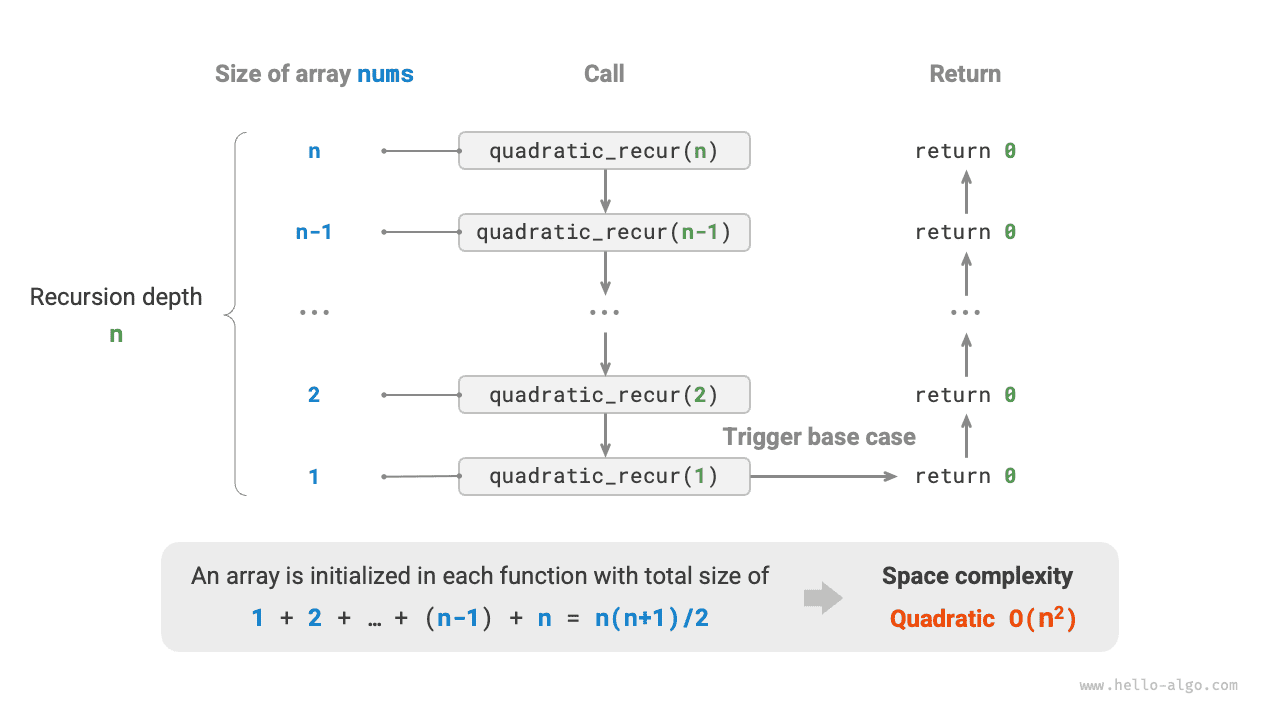
그림 2-18 재귀 함수에서 발생하는 제곱 공간 복잡도
4. 지수 공간 \(O(2^n)\)
지수 공간은 이진 트리에 흔히 나타난다. 아래 그림(2-19)에서 층수가 \(n\)인 ‘포화 이진 트리’의 노드 수는 \(2^n - 1\)이므로 \(O(2^n)\) 공간을 차지한다.
코드 시각화
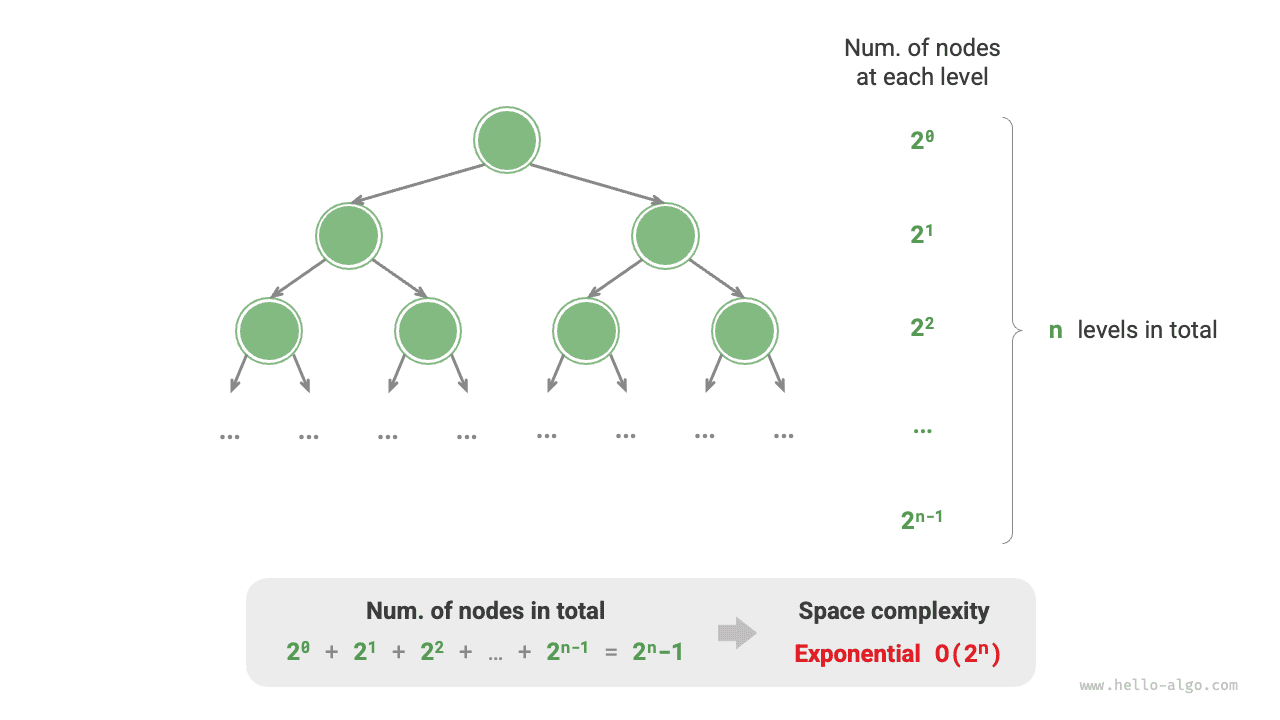
그림 2-19 포화 이진 트리에서 발생하는 지수 공간 복잡도
5. 로그 공간 \(O(\log n)\)
로그 공간은 분할 정복 알고리즘에 흔히 나타난다. 예를 들어 병합 정렬은 길이가 \(n\)인 배열을 입력받아 재귀 호출마다 중간 지점에서 반으로 나눈다. 높이가 \(\log n\)인 재귀 트리가 만들어지므로 \(O(\log n)\)의 스택 프레임 공간을 사용한다.
또 다른 예로 수를 문자열로 변환하는 경우를 보자. 양의 정수 \(n\)을 입력받으면 자릿수는 \(\lfloor \log_{10} n \rfloor + 1\)이며, 대응하는 문자열 길이도 \(\lfloor \log_{10} n \rfloor + 1\)이다. 따라서 공간 복잡도는 \(O(\log_{10} n + 1) = O(\log n)\)이다.
2.4.4 시간과 공간의 절충
이상적으로는 알고리즘의 시간 복잡도와 공간 복잡도가 모두 최적이기를 바란다. 그러나 실제로 두 복잡도를 동시에 최적화하기는 대개 매우 어렵다.
시간 복잡도를 낮추려면 보통 공간 복잡도가 높아지는 대가를 치러야 하며, 그 반대도 마찬가지다. 메모리 공간을 더 사용하여 실행 속도를 높이는 방식을 ‘공간으로 시간을 절약하기’, 반대의 방식을 ‘시간으로 공간을 절약하기’라고 한다.
어떤 방식을 선택할지는 어느 쪽을 더 중시하는지에 달려 있다. 대부분의 경우 시간이 공간보다 귀하므로 ‘공간으로 시간을 절약하기’가 더 널리 쓰인다. 물론 데이터 양이 매우 많다면 공간 복잡도를 관리하는 것 역시 중요하다.